The Car Accident Settlement Process: Step by Step
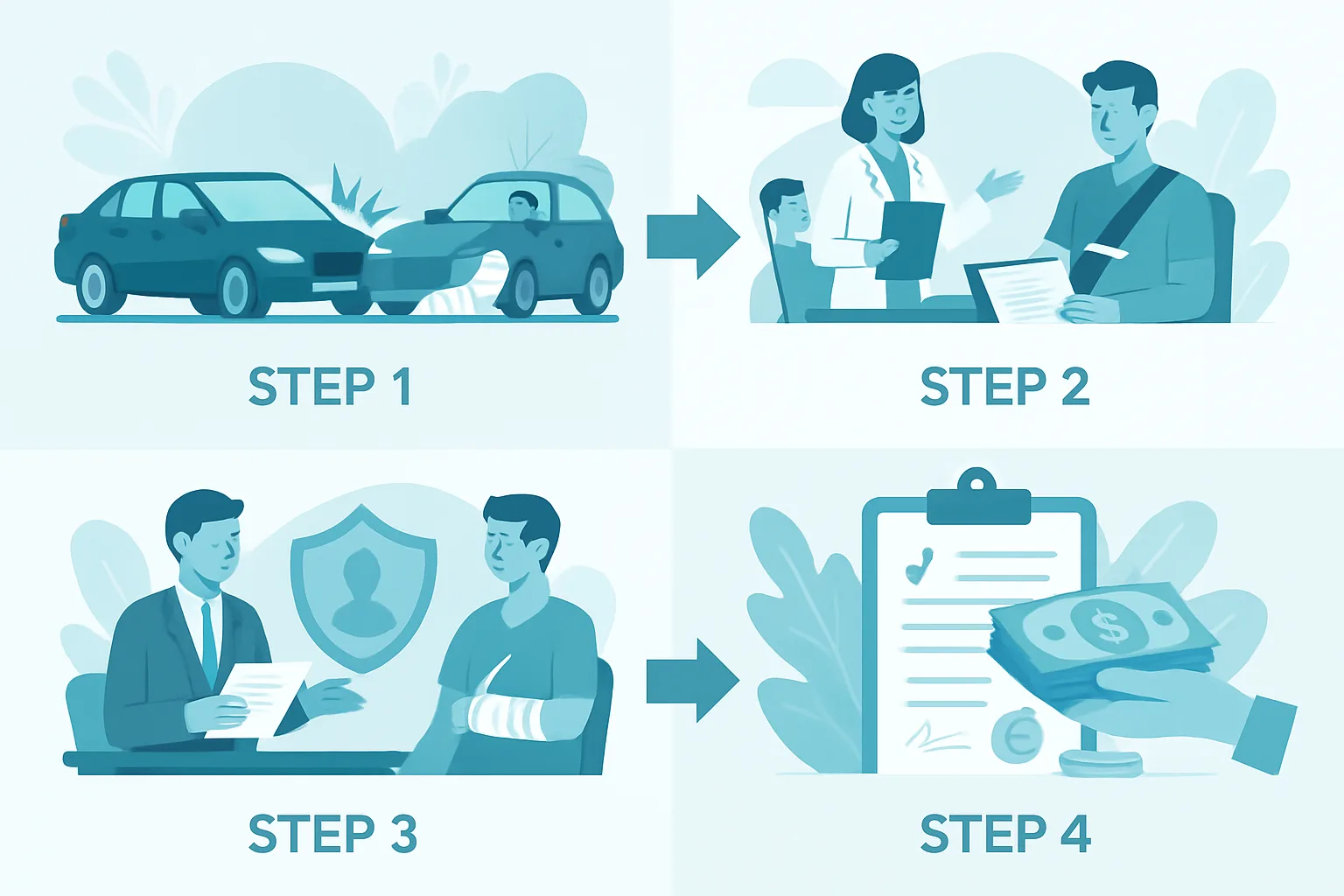
- Prioritize safety, call 911, and gather evidence like photos and witness info.
- Seek medical attention immediately and document all treatment to link injuries to the accident.
- Negotiate with the insurance adjuster using a demand letter, and consider a lawsuit if offers are unfair.
If you've been injured in a car accident, understanding the car accident settlement process can help you navigate the claims system with confidence. While every case is unique, the general steps are consistent across most personal injury claims. This guide walks you through each stage, from the immediate aftermath to receiving your settlement check. Remember, this information is general and not legal advice; consult an attorney for your specific situation.
The goal of a settlement is to compensate you for losses such as medical bills, lost wages, property damage, and pain and suffering. Insurance companies are businesses that aim to minimize payouts, so knowing the process empowers you to advocate for fair treatment. Below, we break down the journey from crash to compensation.
Step 1: Immediate Steps After the Accident
Ensure Safety and Call 911
Your first priority is safety. Move to a safe location if possible, and call 911 to report the accident. Police will document the scene, which creates an official report—a critical piece of evidence. Even in minor accidents, a police report provides an unbiased account of what happened. For example, if the other driver claims you ran a red light but the police report notes skid marks and witness statements that contradict that, the report becomes a powerful tool in proving liability. Without it, the insurance adjuster may rely solely on the other driver's version of events, which could harm your claim. In some jurisdictions, you can request a copy of the police report online or through the local police department within a few days after the accident. Make sure to obtain this document early, as it often contains the responding officer's observations, diagrams of the scene, and citations issued, all of which can strengthen your case. Additionally, if the police officer issues a ticket to the other driver for a violation like speeding or failure to yield, that citation can serve as strong evidence of fault. For instance, if the other driver receives a citation for running a stop sign, the insurance company will likely accept liability without extensive dispute, speeding up the settlement process.
Exchange Information and Gather Evidence
Exchange names, contact details, insurance information, and license plate numbers with the other driver. If there are witnesses, get their contact information. Use your phone to take photos and videos of the accident scene, vehicle damage, skid marks, traffic signs, and your injuries. This evidence can be invaluable later when proving liability and damages. For instance, a photo showing that the other driver's car was blocking a stop sign can clearly demonstrate fault. Similarly, a video of your injuries, such as visible bruising or difficulty moving, can help document pain and suffering. In addition to photos, consider taking notes about the weather conditions, road surface, and time of day. For example, if the accident occurred at dusk on a wet road, these details might explain why the other driver lost control. Also, ask witnesses for a brief written statement or record their account on your phone if they consent. This evidence can prevent disputes later, especially if memories fade or witnesses become unavailable. It is also wise to check for nearby security cameras or dashcams that may have captured the accident. For example, a storefront camera might show the other driver speeding through an intersection, providing irrefutable proof of fault. If you identify such cameras, note the location and ask the business owner for a copy of the footage as soon as possible, as recordings are often overwritten within days.
Seek Medical Attention
Even if you feel fine, see a doctor as soon as possible. Some injuries, like whiplash or internal injuries, may not show symptoms immediately. Medical records linking your injuries to the accident are essential for your claim. Delaying treatment can give the insurance company a reason to argue that your injuries are not serious or were caused by something else. For example, if you wait three days to see a doctor after a rear-end collision, the adjuster might claim that your back pain is from a pre-existing condition or an unrelated activity, such as lifting furniture at home. To avoid this, visit an emergency room or urgent care center right after the accident. Follow all treatment recommendations, including follow-up appointments, physical therapy, or diagnostic tests like X-rays or MRIs. Keep a journal documenting your pain levels, limitations, and emotional distress, as this can support your claim for non-economic damages. Remember, insurance adjusters scrutinize gaps in treatment, so consistent medical care is crucial. For instance, if you are prescribed physical therapy three times a week for six weeks, attending every session demonstrates that you are taking your recovery seriously and that your injuries are genuine. Missing appointments or stopping treatment early can be interpreted as a sign that your injuries are not as severe as claimed, potentially reducing your settlement offer.
Step 2: Notify Your Insurance Company
Contact your own insurance company promptly to report the accident. Provide basic facts but avoid admitting fault or giving a recorded statement until you've consulted an attorney. Your insurer will open a claim and assign a claims adjuster. If the other driver was at fault, you may also file a claim with their insurer. Be aware of your policy's deadlines for reporting accidents. For example, many auto insurance policies require you to report an accident within 24 hours or a few days, or they may deny coverage. If you miss this deadline, you could lose your right to benefits, even if the accident was not your fault. When you call, stick to the facts: state the date, time, location, and parties involved. Do not speculate about who caused the crash or apologize, as these statements can be used against you later. If the adjuster pressures you for a recorded statement, politely decline and say you will provide one after consulting legal counsel. An attorney can help you navigate this step to protect your rights. Additionally, if you have uninsured or underinsured motorist coverage, notify your insurer of that as well, especially if the at-fault driver may have insufficient insurance. For example, if you are hit by a driver with a minimal policy, your own UM/UIM coverage can fill the gap, but you must report the accident and file a claim under that coverage promptly to preserve your rights.
Step 3: The Insurance Investigation
Once a claim is filed, the insurance adjuster will investigate to determine liability and evaluate damages. They will review the police report, photos, medical records, and any other evidence. They may also interview witnesses and inspect your vehicle. During this phase, the adjuster might ask for a recorded statement—it's often wise to decline until you have legal representation, as adjusters are trained to ask questions that can minimize your claim. For instance, an adjuster might ask, "Were you looking at your phone before the crash?" or "Had you been drinking coffee?" These questions are designed to find any hint of negligence on your part, even if you were fully attentive. If you answer without an attorney present, you might inadvertently say something that undermines your case, such as "I'm not sure" or "I might have been distracted for a second." Such statements can be used to reduce your settlement or deny liability altogether.
The adjuster will also calculate a preliminary value for your claim based on medical expenses, lost income, property damage, and pain and suffering. They may use computer software or guidelines to estimate a range. Understanding the car accident settlement value helps you know what to expect. For example, if your medical bills total $5,000 and you missed two weeks of work at $1,000 per week, the adjuster might start with a base of $7,000 for economic damages. Then, they might multiply that by a factor of 1.5 to 3 for pain and suffering, depending on injury severity, resulting in an initial offer of $10,500 to $21,000. However, this is just a starting point. The adjuster will also consider policy limits—if the at-fault driver only has $25,000 in coverage, your settlement cannot exceed that amount, regardless of your actual damages. Knowing these factors helps you evaluate whether an offer is fair or requires negotiation. The adjuster may also request authorization to obtain your medical records, which can delay the investigation if you do not respond promptly. To keep the process moving, provide the necessary authorizations quickly, but review them carefully to ensure they are not overly broad. For example, a release that allows the adjuster to access all of your medical history for the past ten years could reveal unrelated conditions that the adjuster might use to argue your injuries are pre-existing. Your attorney can help you limit the scope of such requests.
Step 4: Demand Letter and Negotiation
After the investigation, your attorney (if you have one) will send a demand letter to the insurance company. This letter outlines the facts, liability, and a detailed calculation of your damages, including a specific settlement amount you are requesting. The insurance company will respond with a counteroffer, often much lower than your demand. Negotiation begins. For instance, if your demand is $50,000 based on $15,000 in medical bills, $5,000 in lost wages, and $30,000 for pain and suffering, the adjuster might counter with $20,000, arguing that your injuries are not as severe as claimed. Your attorney will then provide additional evidence, such as a doctor's note stating that your recovery will take six months, to justify the higher amount.
Negotiation can involve multiple rounds of offers and counteroffers. Insurance adjusters may use tactics like delaying, disputing liability, or questioning the severity of your injuries. Patience is key. An experienced attorney can handle these negotiations to push for a fair settlement. The average car accident settlement amount varies widely depending on factors like injury severity, medical costs, and insurance limits. Your case may settle for more or less than average. For example, a minor fender bender with soft tissue injuries might settle for $5,000 to $15,000, while a severe crash involving broken bones and surgery could settle for $100,000 or more. Your attorney will use their knowledge of local verdicts and settlement trends to advocate for the best outcome. During negotiation, it is common for the adjuster to request additional documentation, such as a narrative report from your doctor explaining the prognosis and long-term impact of your injuries. Providing this report can strengthen your position and justify a higher settlement. For example, if your doctor states that you will need ongoing physical therapy for a year and may have permanent limitations, the adjuster is more likely to offer a larger amount to account for future medical costs and reduced quality of life.
Step 5: Settlement or Lawsuit
If negotiations succeed, you will reach a settlement agreement. Before signing, review the terms carefully. The settlement typically releases the other party from future liability, so ensure it covers all your current and anticipated future losses. Once signed, you receive the settlement check, which may take a few weeks to clear. The timeline from accident to settlement can vary; learn more about how long does a car accident settlement take. For example, a straightforward case with clear liability and moderate injuries might settle in three to six months, while a complex case involving multiple parties or disputed liability could take a year or more.
If the insurance company refuses to offer a fair amount, you may need to file a lawsuit. Most personal injury cases settle before trial, but litigation can extend the process by months or years. Your attorney will guide you through discovery, depositions, and potential mediation. Only a small percentage of cases go to trial. For instance, if the insurance company offers only $10,000 for a case worth $50,000, your attorney might file a lawsuit to pressure them into a better offer. During discovery, both sides exchange evidence, and depositions allow attorneys to question witnesses under oath. Mediation, a form of settlement negotiation with a neutral third party, often resolves cases before trial. If a trial does occur, a jury or judge will decide the outcome, but this is rare because both parties prefer to avoid the uncertainty and expense of court. It is important to understand that filing a lawsuit does not mean you will go to trial; in fact, many cases settle after a lawsuit is filed because the insurance company realizes the strength of your case. For example, after filing a lawsuit, the defense may review your medical records and deposition testimony and decide that a trial could result in a large verdict, prompting them to offer a fair settlement to avoid that risk.
Step 6: Receiving Your Settlement
Once a settlement is reached, the insurance company issues a check. If you have medical liens (e.g., from health insurance or Medicare), those must be paid first. Your attorney will deduct their contingency fee and any case costs from the remaining amount. You then receive your share. Be aware that some settlement money may be taxable—for example, punitive damages are taxable, while compensation for physical injuries generally is not. Consult the IRS guidelines on settlement taxation for details. For instance, if your settlement includes $5,000 for pain and suffering and $2,000 for punitive damages, the $5,000 is not taxable, but the $2,000 is. Your attorney should provide a detailed breakdown of the settlement distribution, showing how much goes to liens, fees, and your net recovery. Keep copies of all documents for tax purposes. The settlement check may be issued in the name of you and your attorney, requiring both signatures to deposit. This process ensures that liens and fees are paid before you receive your portion. For example, if your settlement is $100,000, and you have a $10,000 medical lien and a 33% contingency fee of $30,000, your net recovery after costs might be around $57,000, depending on additional case expenses like court filing fees or expert witness costs. Review the settlement statement carefully to ensure all deductions are accurate and authorized.
Factors That Affect Your Settlement
Several factors influence the value of your claim: the severity of injuries, clarity of liability, insurance policy limits, and whether you share any fault. In states with comparative negligence rules, your settlement may be reduced by your percentage of fault. For example, if you are 20% at fault, your award is reduced by 20%. Medical documentation, lost wage verification, and evidence of pain and suffering all play a role. For instance, if you have a herniated disc requiring surgery, your settlement will be higher than if you have minor whiplash that resolves in a few weeks. Similarly, if the other driver ran a red light and you have a police report confirming this, liability is clear, making it easier to negotiate a fair settlement. However, if the accident occurred at an intersection with no witnesses and both drivers claim the other was at fault, liability is disputed, and the case may be worth less or require litigation. Another critical factor is the availability of insurance coverage. If the at-fault driver has no insurance or is underinsured, your settlement may be limited to your own policy's uninsured motorist coverage, which might not fully compensate you for severe injuries. For example, if you have $25,000 in UM coverage but your medical bills are $40,000, you may only recover $25,000, leaving you to cover the remaining $15,000 out of pocket. Additionally, if you have pre-existing conditions, such as a prior back injury, the insurance company may argue that your current symptoms are related to that condition rather than the accident. To counter this, your attorney can obtain medical records showing that your pre-existing condition was stable and asymptomatic before the crash, and that the accident aggravated it, which still entitles you to compensation for the worsened condition.
When to Hire a Car Accident Attorney
While you can handle a simple claim on your own, hiring an attorney is advisable if you have serious injuries, disputed liability, or an uncooperative insurance company. Attorneys understand the legal process, can accurately value your claim, and negotiate effectively. Most work on a contingency fee basis, meaning they only get paid if you win. Even if you decide to handle the claim yourself, many attorneys offer free initial consultations to discuss your options. For example, if you have a broken leg requiring surgery and physical therapy, an attorney can help calculate future medical costs and lost earning capacity, which are often overlooked by accident victims. Additionally, if the insurance company is delaying or denying your claim, an attorney can file a bad faith claim or take legal action to compel them to act. Remember, the cost of hiring an attorney is often outweighed by the higher settlement they can secure. For instance, an attorney might secure a $50,000 settlement for a case where you might have accepted $20,000 on your own, and after a 33% contingency fee of $16,500, you still net $33,500, which is $13,500 more than you would have received without representation. Attorneys also handle the paperwork, deadlines, and communications with the insurance company, reducing your stress and allowing you to focus on recovery. If your case involves multiple parties, such as a commercial truck accident or a ride-share vehicle, an attorney is essential to navigate the complex liability and insurance issues involved.
Common Mistakes to Avoid
- Admitting fault at the scene or to the adjuster. For example, saying "I'm sorry" or "I didn't see you" can be used as an admission of liability.
- Delaying medical treatment or missing follow-up appointments. This can create a gap in your medical records that the adjuster will use to argue your injuries are not serious.
- Accepting the first settlement offer without negotiation. Initial offers are often low; for instance, an adjuster might offer $5,000 for a claim worth $20,000, hoping you will accept quickly.
- Signing a release before understanding all terms. Once you sign, you cannot seek additional compensation, even if you discover new injuries later.
- Posting about the accident on social media. Insurance companies monitor social media for evidence that contradicts your claim, such as photos of you at a party after claiming severe pain.
Another common mistake is failing to keep a record of all accident-related expenses. For example, if you pay for prescription medications, over-the-counter pain relievers, or transportation to medical appointments out of pocket, these costs can be included in your claim for economic damages. Without receipts or a log, you may forget to claim these amounts, reducing your total recovery. Similarly, if you miss work for medical appointments, document the time off with a note from your doctor and your employer to ensure you are compensated for lost wages. Finally, avoid discussing your case with anyone other than your attorney and medical providers. Conversations with friends, family, or even the other driver's insurance company can be used against you if they are overheard or recorded. For instance, telling a friend that you are "feeling better" could be interpreted by the adjuster as evidence that your injuries have fully resolved, even if you are still in pain.
How to Document Your Damages for a Stronger Claim
Proper documentation is the backbone of a successful settlement. Start by keeping a folder with all accident-related records, including the police report, medical bills, prescription receipts, and correspondence with insurance companies. For lost wages, obtain a letter from your employer stating your hourly rate, missed days, and any lost overtime or bonuses. For example, if you missed two weeks of work at $20 per hour, your lost wages are $1,600, but if you also lost a $500 bonus because of missed days, include that as well. For pain and suffering, maintain a daily journal describing how your injuries affect your life, such as difficulty sleeping, inability to play with your children, or emotional distress like anxiety when driving. This journal can be powerful evidence at trial or during mediation. Additionally, take photos of your injuries over time to show the healing process or any scarring. For property damage, get repair estimates and photos of the damage. The more comprehensive your documentation, the harder it is for the insurance company to dispute your claim. It is also helpful to organize your documents chronologically and by category, such as medical records, wage loss verification, and property damage estimates. For instance, create a spreadsheet listing each medical visit, the date, the provider, the treatment received, and the cost. This makes it easy for your attorney or the adjuster to review your damages at a glance. If you have ongoing treatment, update your documentation regularly to ensure nothing is missed. Finally, keep copies of all correspondence with insurance companies, including emails, letters, and notes from phone calls, noting the date, time, and the name of the person you spoke with. This record can be crucial if the insurance company later claims they never received a document or that you agreed to a lower offer.
Understanding Insurance Policy Limits and Their Impact
Insurance policy limits are the maximum amount an insurance company will pay for a claim. If the at-fault driver has low limits, your settlement may be capped, even if your damages are higher. For example, if the other driver has a policy limit of $25,000 per person and your medical bills alone are $50,000, you cannot recover more than $25,000 from that policy. In such cases, you may need to pursue additional compensation through your own uninsured/underinsured motorist (UM/UIM) coverage, if you have it. UM/UIM coverage pays for your damages when the at-fault driver lacks sufficient insurance. For instance, if you have $50,000 in UM/UIM coverage and the other driver's policy only pays $25,000, your insurer may cover the remaining $25,000, subject to your policy terms. It is important to review your own policy to understand your coverage limits and whether you have UM/UIM protection. If you are unsure, consult your insurance agent or an attorney to explore all avenues for compensation. Additionally, some states require insurance companies to offer UM/UIM coverage, but you may have rejected it in writing when you purchased your policy. If you rejected it, you may have limited options for recovering additional compensation beyond the at-fault driver's policy. For example, if you were in a serious accident with $100,000 in damages and the at-fault driver has only $25,000 in coverage, and you rejected UM/UIM coverage, you may only recover $25,000, leaving you to cover the remaining $75,000 on your own. This underscores the importance of carrying adequate UM/UIM coverage, especially if you live in a state with many uninsured drivers. If you are unsure about your policy, request a copy of your declarations page from your insurer, which lists all coverage limits and any rejections you have signed.
The Role of Mediation in the Settlement Process
Mediation is a voluntary process where a neutral third party, called a mediator, helps both sides negotiate a settlement. It is often used when initial negotiations stall or before a trial to avoid the cost and time of litigation. During mediation, each side presents their case, and the mediator facilitates discussions to find common ground. For example, if you are demanding $100,000 but the insurance company is offering $60,000, the mediator might suggest a compromise of $80,000 based on the strengths and weaknesses of each side. Mediation is confidential, meaning statements made during the session cannot be used in court if the case proceeds to trial. It is often less stressful than a trial and can resolve a case in a single day. Many courts require mediation before a trial date is set. If you have an attorney, they will prepare you for mediation by summarizing your evidence and advising you on a reasonable settlement range. Even if mediation does not result in a settlement, it can clarify the issues and narrow the disputes, making a future trial more efficient. For instance, during mediation, the insurance company might agree that liability is clear but dispute the extent of your injuries, allowing both sides to focus on the medical evidence rather than arguing about fault. Mediation also gives you an opportunity to hear the insurance company's perspective directly, which can help you decide whether to accept a settlement or proceed to trial. While mediation is not binding, if both parties agree to a settlement, it becomes a binding contract. In some cases, the mediator may make a "mediator's proposal," where they suggest a specific settlement amount, and each side has a deadline to accept or reject it. If both sides accept, the case settles; if one rejects, the case moves toward trial. This process can be an effective way to break a deadlock and avoid the expense of litigation.
How to Handle a Disputed Liability Claim
Disputed liability occurs when the at-fault driver denies responsibility or when both drivers blame each other for the accident. In such cases, the insurance company may delay or deny your claim, making it harder to reach a settlement. To handle a disputed liability claim, gather as much evidence as possible to prove the other driver's fault. For example, if the accident occurred at an intersection with a traffic light, look for surveillance footage from nearby businesses or traffic cameras. Witness statements are also critical; if a pedestrian saw the other driver run a red light, their testimony can be decisive. Additionally, consider hiring an accident reconstruction expert who can analyze the scene, vehicle damage, and skid marks to determine how the crash occurred. For instance, an expert might calculate the speed of each vehicle based on skid mark length and damage patterns, showing that the other driver was speeding and lost control. If liability remains disputed, your attorney may file a lawsuit to compel the insurance company to defend its position in court. During litigation, both sides will conduct discovery, and depositions can reveal inconsistencies in the other driver's story. For example, if the other driver claims they were stopped at a red light, but a witness testifies that they saw the other driver's car moving, that contradiction can undermine their credibility. In some cases, the insurance company may agree to a settlement even if liability is disputed, but the amount may be lower to account for the risk of losing at trial. For instance, if you have strong evidence of the other driver's fault, the insurance company might offer 70% of your damages rather than 100%, reflecting the uncertainty of a trial outcome. Your attorney can advise you on whether to accept such an offer or proceed to trial based on the strength of your evidence.
Key takeaways
- The car accident settlement process involves immediate steps, claim filing, investigation, negotiation, and settlement or lawsuit.
- Gathering evidence and seeking prompt medical care are critical to building a strong case.
- Insurance adjusters aim to minimize payouts; be cautious with recorded statements and initial offers.
- Consult an attorney if injuries are severe or liability is disputed.
- Understand that settlement amounts vary based on individual factors; do not rely on averages alone.
Frequently asked questions
How long does the car accident settlement process take?
Do I need a lawyer for a car accident settlement?
What is the average car accident settlement amount?
Can I still get a settlement if I was partly at fault?
What costs are covered in a car accident settlement?
This article is for general informational purposes only and does not constitute legal advice. Always consult a qualified professional about your specific circumstances.

Written & reviewed by
Can OTUConsumer Legal Information Researcher & Editor
Can OTU researches and edits every guide on this site, drawing on primary legal sources, court records, and state statutes to produce accurate, plain-English explanations of U.S. compensation and personal injury claims.
View all guides →