Can You Be Fired While on Workers Comp?

- Retaliation for filing a workers comp claim is prohibited by law in nearly every state.
- You can be fired for poor performance, misconduct, or layoffs even while on workers' comp.
- If you suspect retaliation, document everything and consult an attorney immediately.
If you are receiving workers' compensation benefits after a work injury, you may worry about job security. The fear of being terminated while on workers comp is common, but the law provides important protections. This article explains your rights, the exceptions, and what to do if you face termination.
Workers' compensation is a no-fault system designed to provide medical care and wage replacement for employees injured on the job. In exchange, employees generally give up the right to sue their employer for negligence. However, the law does not allow employers to punish you for exercising your right to file a workers compensation claim.
This article provides general information, not legal advice. Laws vary by state, so you should consult with a qualified attorney for advice specific to your situation.
Is It Illegal to Be Fired While on Workers Comp?
Yes, in almost every state, it is illegal for an employer to fire you solely because you filed a workers compensation claim or are receiving benefits. This is known as retaliation or discrimination. The specific laws vary, but the core protection is widespread.
For example, many states have statutes that explicitly prohibit employers from discharging or discriminating against an employee because the employee filed a claim. Some states also protect employees who testify in a workers comp proceeding or who refuse to violate safety rules.
However, the protection is not absolute. You can still be fired for reasons unrelated to your injury, such as poor performance, misconduct, or a reduction in force. The key is whether the termination was motivated by your workers comp claim.
Understanding Retaliation in Practice
Retaliation often happens subtly. An employer might suddenly cite minor infractions after you file a claim. For instance, if you had no write-ups for years, then get fired for a small mistake, it may be retaliation.
Courts look at timing and context. If termination occurs shortly after you file a claim, it raises suspicion. However, a long gap does not automatically prove the firing was legal.
You must show that the workers comp claim was a motivating factor. This does not mean it has to be the only reason. Even if mixed with other factors, retaliation can still be proven.
Examples of Retaliation Scenarios
Consider a warehouse worker who files a claim after a back injury. Two days later, the employer fires him for allegedly failing to clean his workstation. If other employees with similar infractions were not fired, this suggests retaliation.
Another example is an office manager who files a claim for carpal tunnel syndrome. Her employer then demotes her to a janitorial role with lower pay. This demotion could be a form of retaliation, even if she is not fired.
In a third scenario, a nurse files a claim after being assaulted by a patient. The hospital then places her on a performance improvement plan with impossible goals. This may be a pretext for termination later.
What Protections Do You Have Against Retaliation?

State Laws
Most states have specific anti-retaliation laws that protect employees who file workers compensation cases. These laws typically allow you to sue your employer for damages if you are fired in retaliation. Some states also provide for reinstatement, back pay, and attorney's fees.
For instance, California Labor Code Section 132a prohibits discrimination against workers who file claims. Texas does not have a specific statute but allows a claim for wrongful termination under public policy. You should check your state's law or consult an attorney.
State penalties vary widely. In some states, employers face fines or even criminal charges. In others, the only remedy is back pay.
Knowing your state's specific protections is crucial.
Federal Laws
In some situations, federal laws may also protect you. The Americans with Disabilities Act (ADA) may apply if your injury results in a disability. The Family and Medical Leave Act (FMLA) may provide job protection if you need time off for a serious health condition.
However, these laws have specific requirements and do not cover all workers.
Federal protections often overlap with state laws. For example, if your injury qualifies as a disability under the ADA, you may have additional rights. But these laws require you to meet strict eligibility criteria.
You cannot rely on federal law alone. State workers comp laws are usually your first line of defense. An attorney can help you determine which laws apply to your case.
When Can You Be Legally Terminated While on Workers Comp?
Even if you are on workers' comp, your employer can terminate you for legitimate, non-retaliatory reasons. Common examples include:
- Performance issues: If you had documented performance problems before your injury, your employer may use those as grounds for termination.
- Misconduct: Violating company policy, theft, or other misconduct can lead to termination regardless of your workers comp status.
- Layoffs: If your position is eliminated as part of a reduction in force, you can be laid off even if you are on workers' comp.
- Expiration of leave: If you have exhausted all available leave under FMLA or company policy, and you cannot return to work, your employer may terminate you.
It is important to note that the employer must have a legitimate, non-retaliatory reason. If the stated reason is a pretext for retaliation, you may have a claim.
How Employers Justify Termination
Employers often use performance reviews to build a case. If you have a history of warnings, they may argue the firing was justified. For example, if you received three written warnings for tardiness before your injury, termination might be legal.
But if the warnings were issued only after you filed a claim, that is suspicious. Courts will examine the timing and consistency of discipline. An employer who suddenly enforces a rule unevenly may be retaliating.
Layoffs are another common justification. If your entire department is eliminated, you can be laid off. However, if your position is filled shortly after, the layoff claim may be false.
Specific Examples of Legal Termination
A truck driver on workers comp for a shoulder injury is caught falsifying logbooks. This misconduct is unrelated to his claim, so termination is legal. The employer can document the violation and proceed.
A retail worker on workers comp for a foot injury is laid off when the store closes permanently. This is a legitimate business decision. The worker cannot claim retaliation if the layoff is genuine.
A software developer on workers comp for a wrist injury fails to meet project deadlines due to poor time management. If the employer has documented warnings, termination may be legal. The key is the reason must be unrelated to the claim.
What Should You Do If You Are Fired While on Workers Comp?
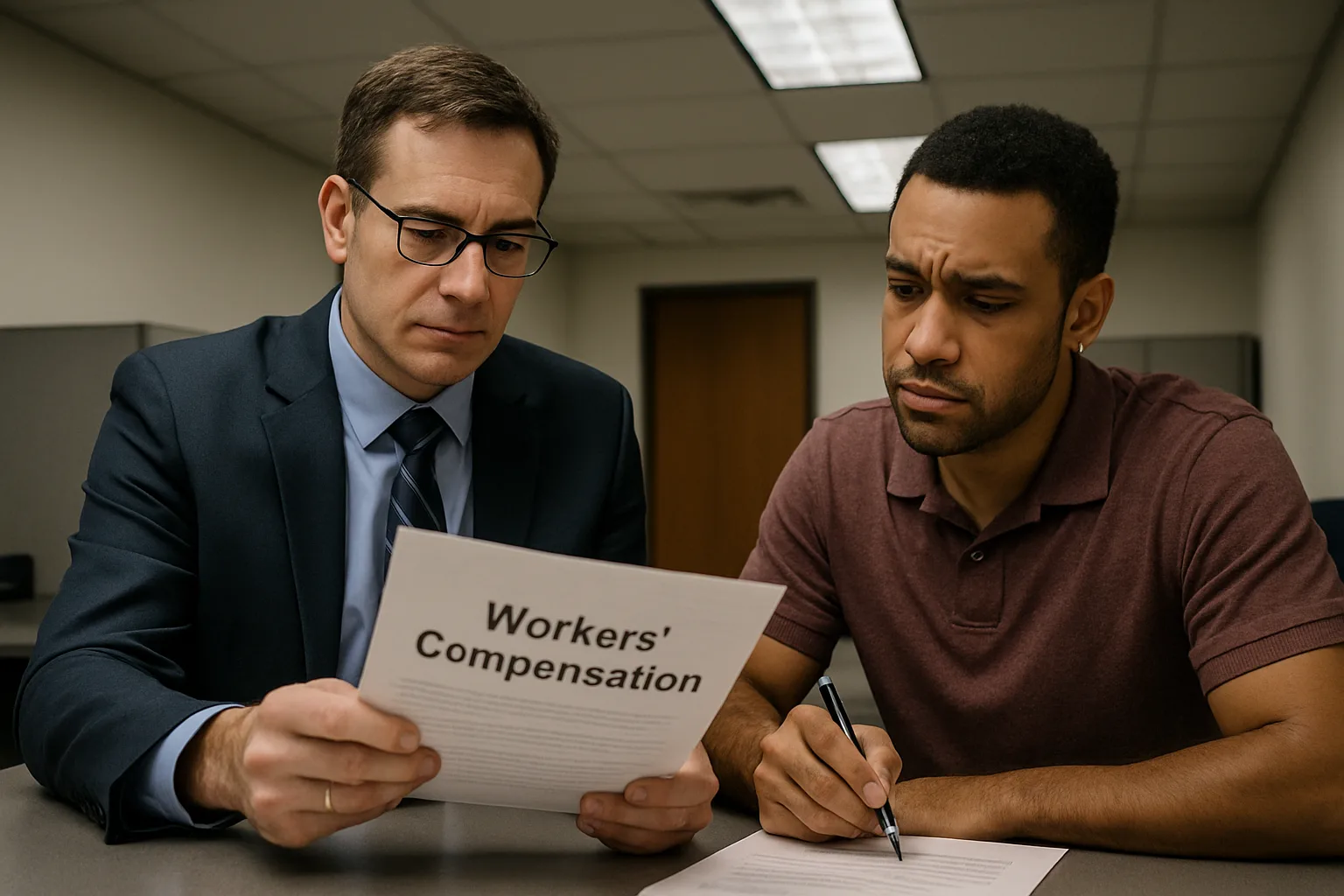
If you believe you were terminated in retaliation for filing a workers comp claim, take the following steps:
- Document everything: Keep copies of all communications with your employer, including emails, letters, and notes about conversations. Record the date and time of any incidents.
- Request a written reason for termination: Ask your employer to provide a written explanation for your firing. This can help you determine if the reason is legitimate or pretextual.
- File a complaint: You can file a complaint with your state's labor department or workers' compensation board. Many states have a process for investigating retaliation claims.
- Consult an attorney: An experienced workers' compensation attorney can evaluate your case and advise you on the best course of action. You may be able to file a workers comp lawsuit for retaliation.
Why Documentation Matters
Documentation creates a paper trail. If you have emails showing your employer was unhappy about your claim, that is strong evidence. Even notes about verbal conversations can help.
For example, if your supervisor said, "I wish you hadn't filed that claim," write it down immediately. Include the date, time, and any witnesses. This can be used in court to show intent.
Without documentation, it is your word against theirs. Employers often deny making such statements. Written evidence makes your case much stronger.
Additional Steps to Protect Yourself
Do not sign any severance agreement without reading it carefully. Some agreements include waivers of your right to sue. An attorney can review the terms before you sign.
Keep copies of your workers comp claim forms and medical records. These documents show the timeline of your injury and claim. They can help establish a connection between the claim and the termination.
File for unemployment benefits immediately. Even if you are on workers comp, you may qualify. This provides income while you pursue your case.
Can You Sue Your Employer for Wrongful Termination?
Yes, if your employer fired you in retaliation for filing a workers comp claim, you may have a wrongful termination claim. Depending on your state, you can sue for damages such as lost wages, emotional distress, and punitive damages. In some states, you may also be entitled to reinstatement.
However, you must act quickly. Statutes of limitations for retaliation claims are often short, sometimes as little as 90 days. Consult an attorney as soon as possible to preserve your rights.
Types of Damages Available
Lost wages include both past and future earnings. If you were fired and could not find a job, you may recover the income you lost. Emotional distress damages cover anxiety, depression, or humiliation caused by the firing.
Punitive damages are rare but possible. They are designed to punish the employer for egregious conduct. For example, if an employer openly threatened to fire anyone who filed a claim, punitive damages may apply.
Reinstatement is not always practical. If the work environment is hostile, you may prefer a financial settlement. Your attorney can help you decide what is best.
Examples of Damage Awards
In a California case, a worker was fired after filing a back injury claim. The court awarded $50,000 in lost wages and $25,000 for emotional distress. The employer also had to pay attorney fees.
In a Texas case, a worker was fired for filing a claim after a fall. The jury awarded $100,000 in punitive damages because the employer had a history of retaliation. The worker also received back pay.
In a New York case, a worker was reinstated to her job with full back pay. The court found the employer's stated reason was a pretext. The worker returned to work with no loss of seniority.
How Does Workers Comp Interact with Other Laws?
FMLA
The Family and Medical Leave Act (FMLA) provides up to 12 weeks of unpaid leave per year for a serious health condition. If your injury qualifies, your employer must reinstate you to your same or equivalent position after leave. However, FMLA only applies to employers with 50 or more employees and requires you to have worked at least 1,250 hours in the past year.
FMLA leave runs concurrently with workers comp leave. This means the 12 weeks may be used up quickly. If you need more time, you may lose job protection.
You must notify your employer of the need for FMLA leave. Failure to do so can waive your rights. Always request FMLA in writing if your injury qualifies.
ADA
The Americans with Disabilities Act (ADA) prohibits discrimination against qualified individuals with disabilities. If your injury results in a disability, your employer may be required to provide reasonable accommodations to allow you to return to work. The ADA applies to employers with 15 or more employees.
Reasonable accommodations might include modified duties, a wheelchair-accessible workspace, or flexible hours. For example, if you cannot lift heavy objects, your employer might reassign those tasks. The employer must engage in an interactive process to find accommodations.
If your employer refuses to accommodate you, you may have an ADA claim. This is separate from a workers comp retaliation claim. An attorney can help you pursue both.
State Laws
Some states have additional protections, such as paid sick leave laws or temporary disability benefits. Check your state's laws for more information.
For instance, New York has a paid family leave program. California offers state disability insurance. These benefits can supplement workers comp while you are out of work.
State laws also vary on what counts as retaliation. Some states protect employees who refuse unsafe work. Others protect employees who testify in hearings.
Know your state's specific provisions.
What If You Cannot Return to Work After Injury?
If your injury prevents you from returning to your previous job, you may be entitled to vocational rehabilitation or job retraining through workers' comp. Some states also offer permanent disability benefits if you have a lasting impairment. Your employer may also have an obligation to offer you a different position if one is available under the ADA or state law.
If you are unable to return to work at all, you may qualify for Social Security Disability Insurance (SSDI) or other benefits. An attorney can help you navigate these options.
Vocational Rehabilitation Options
Vocational rehabilitation helps you find a new career. For example, if you were a construction worker with a back injury, you might be retrained as an office clerk. The program may cover tuition, books, and job placement.
Not all states offer vocational rehab. Some require you to have a certain level of disability. Others limit the amount of training you can receive.
Check with your state's workers comp board.
Even if you return to work, you may still have permanent restrictions. Your employer must accommodate these if possible. If not, you may need to seek new employment.
Permanent Disability Benefits
Permanent disability benefits compensate you for lasting impairment. These are typically paid as a lump sum or weekly payments. The amount depends on the severity of your injury and your state's rating system.
For example, losing the use of a hand might be rated at 50% disability. You would receive a percentage of your wages for a set period. Some states offer lifetime benefits for catastrophic injuries.
These benefits are separate from workers comp wage replacement. They are meant to compensate for permanent loss. An attorney can help you calculate what you are owed.
How to Prove Retaliation in a Workers Comp Case
Proving retaliation requires evidence that your employer acted with a retaliatory motive. This is often done through circumstantial evidence, such as timing, inconsistent treatment, or direct statements.
For instance, if you were fired one day after filing a claim, that timing is suspicious. If your employer gave you positive reviews before the claim and negative ones after, that is also evidence. If a coworker was not fired for the same infraction, that shows disparate treatment.
Direct evidence is rare but powerful. If your boss said, "I'm firing you because you filed a claim," that is direct proof. More often, you must rely on indirect evidence to build your case.
Building a Strong Case
Start by gathering all relevant documents. This includes your employment contract, performance reviews, and any disciplinary records. Also collect your workers comp claim forms and medical records.
Witnesses can be crucial. If a coworker heard your supervisor make a threatening comment, ask them to provide a statement. Their testimony can corroborate your account.
An attorney can help you organize this evidence. They know what courts look for and can advise you on the strength of your case. Do not try to handle this alone.
Common Evidence Used in Retaliation Cases
Emails are often key evidence. If your manager sent an email criticizing you for filing a claim, save it. Print copies and store them in a safe place.
Performance reviews can show a pattern. If your reviews were positive for years, then suddenly negative after the claim, that is suspicious. Compare reviews from before and after the injury.
Attendance records can also help. If you were never disciplined for absences before, but are fired for missing work due to the injury, that may indicate retaliation. The employer must treat all employees consistently.
What to Expect in a Retaliation Lawsuit
Filing a retaliation lawsuit involves several steps. First, you must typically exhaust administrative remedies, such as filing a complaint with a state agency. Then, if the agency does not resolve the issue, you can file a lawsuit in court.
The lawsuit process includes discovery, where both sides exchange evidence. Depositions may be taken, and motions may be filed. Many cases settle before trial, but some go to a jury.
If you win, you may be awarded damages, attorney's fees, and costs. If you lose, you may owe nothing but your own legal fees. Most attorneys work on a contingency basis, meaning they only get paid if you win.
Timeline of a Typical Case
A retaliation case can take months or years. Simple cases may settle in 6-12 months. Complex cases with extensive discovery can take 2-3 years.
Your attorney will keep you informed of progress. Be patient and follow their advice. Rushing into a settlement may leave money on the table.
Statutes of limitations are strict. Missing a deadline can bar your claim entirely. Act as soon as possible after termination.
What Happens During Discovery
Discovery involves exchanging documents and information. Your attorney will request the employer's personnel files, emails, and policies. The employer will also request your medical records and claim documents.
Depositions are sworn interviews. You may be deposed by the employer's lawyer. Your attorney will prepare you for this process.
Answer questions truthfully and concisely.
Motions can be filed to dismiss the case or for summary judgment. If the judge finds no genuine issue of fact, the case may be decided without trial. Your attorney will argue against such motions.
Common Myths About Workers Comp Termination
Many employees believe they cannot be fired at all while on workers comp. This is false. You can be fired for legitimate reasons, as discussed earlier.
Another myth is that you must be reinstated after recovery. Unless you have FMLA or ADA protection, your employer may not have to rehire you. They only must avoid retaliation.
Some think that filing a claim guarantees job security. It does not. It only protects you from retaliation for filing the claim.
Your job is still at risk for other reasons.
Debunking Misinformation
Misinformation can lead to poor decisions. For example, some employees avoid filing claims out of fear of termination. This can cost them benefits they are entitled to.
Others assume they are safe from layoffs. They may stop looking for work, only to be surprised by a termination. Stay informed and consult an attorney.
Always verify information with a legal professional. Online forums and coworkers may give inaccurate advice. Your attorney is the best source of guidance.
More Myths to Ignore
Some believe that if you are fired, your workers comp benefits stop immediately. This is false. Benefits continue until you are medically cleared or reach maximum medical improvement.
Another myth is that you cannot collect unemployment while on workers comp. In many states, you can if you are able to work with restrictions. Check your state's rules.
A final myth is that you must accept any job offer from your employer. If the job violates your medical restrictions, you can refuse. Always follow your doctor's advice.
The Role of Light Duty and Modified Work
Many employers offer light duty or modified work to injured employees. Light duty means tasks that accommodate your physical restrictions. If you refuse a legitimate light duty offer, your workers comp benefits may be reduced or stopped.
However, you cannot be forced into light duty that violates your doctor's restrictions. For example, if your doctor says no lifting over 10 pounds, a job requiring 20-pound lifts is inappropriate. Your employer must follow medical guidelines.
If you accept light duty, you are still protected from retaliation. Firing you for accepting light duty is illegal. Your workers comp claim remains active while you work modified hours.
What Happens If Light Duty Ends
Light duty positions are often temporary. If your employer eliminates the light duty role, you may be laid off. But this must be a genuine elimination, not a pretext for retaliation.
For instance, if your employer creates a light duty job for you, then fires you when your benefits run out, that may be retaliation. Courts will examine whether the job was real or a sham.
If light duty ends, you may return to workers comp benefits. Your doctor must certify that you are still unable to perform your regular job. Keep your medical records updated.
Examples of Light Duty Issues
A warehouse worker with a knee injury is offered a light duty job sorting boxes. If the job requires standing for eight hours and his doctor says no standing, he can refuse. The employer must find a different accommodation.
A secretary with a wrist injury is offered a light duty job answering phones. This may be appropriate if it does not aggravate the injury. If she accepts, her benefits may be reduced.
A construction worker with a back injury is offered a light duty job as a flagger. If the job requires standing and his doctor says no standing, he can refuse. The employer cannot force him to accept.
How to Handle a Hostile Work Environment After Filing a Claim
Sometimes employers do not fire you but make work unbearable. This is called constructive discharge. If you quit because of a hostile environment, you may still have a retaliation claim.
Examples of hostility include constant criticism, demotion, or exclusion from meetings. If your supervisor suddenly gives you impossible deadlines, that may be retaliation. Document every incident.
Constructive discharge is hard to prove. You must show that a reasonable person would have quit. Consult an attorney before resigning to protect your rights.
Steps to Address Hostility
First, report the behavior to HR or a supervisor. Use your employer's internal complaint process. This creates a record and may stop the harassment.
Second, keep a journal of hostile acts. Include dates, times, and witnesses. If the behavior continues, you have evidence for a lawsuit.
Third, do not retaliate yourself. Stay professional and follow company rules. If you are fired for misconduct, your claim may be weakened.
Examples of Hostile Work Environment
A factory worker files a claim for a hand injury. Her supervisor then assigns her to the dirtiest tasks and criticizes her work constantly. Other employees are not treated this way.
An office worker files a claim for a back injury. His manager excludes him from team meetings and gives him no assignments. He feels isolated and eventually quits.
A nurse files a claim for a needle stick injury. Her supervisor reduces her hours and gives her the least desirable shifts. This may be retaliation, even if she is not fired.
Key Takeaways
- It is generally illegal to be fired solely for filing a workers comp claim or receiving benefits.
- You can still be terminated for legitimate reasons like performance issues, misconduct, or layoffs.
- If you suspect retaliation, document everything and consult an attorney promptly.
- State laws vary, so check your specific state's protections.
- Other laws like FMLA and ADA may provide additional job protection.
Frequently asked questions
Can you be fired while on workers comp?
What should I do if I am fired while on workers comp?
Is retaliation for filing a workers comp claim illegal?
Can I sue my employer for wrongful termination while on workers comp?
Does FMLA protect my job while on workers comp?
This article is for general informational purposes only and does not constitute legal advice. Always consult a qualified professional about your specific circumstances.

Written & reviewed by
Can OTUConsumer Legal Information Researcher & Editor
Can OTU researches and edits every guide on this site, drawing on primary legal sources, court records, and state statutes to produce accurate, plain-English explanations of U.S. compensation and personal injury claims.
View all guides →